


Governance
Corporate Governance
Fundamental Concept of Corporate Governance
Komori understands that it is one of the most important material issues in its business activities under its corporate philosophy of becoming a “Kando Kigyo” (company that goes beyond expectations) to meet expectations from all stakeholders, including shareholders, customers, suppliers, local communities, and employees and their families, fulfill its responsibilities, and maximize corporate value, while promoting through the creation of Kando activities driven by high management quality: 1. thorough perceptual quality control and implementation of the solution business, 2. implementation Komori-way workstyle reforms (K-Work), and 3. building deep cocreation and collaboration with partner companies. To accelerate decision-making, enhance the effectiveness of the Board of Directors, and strengthen its monitoring function, the Company transitioned from a company with board of company auditors to a company with audit and supervisory committee upon approval at the 79th Ordinary Meeting of Shareholders on June 18, 2025.
Corporate governance structure
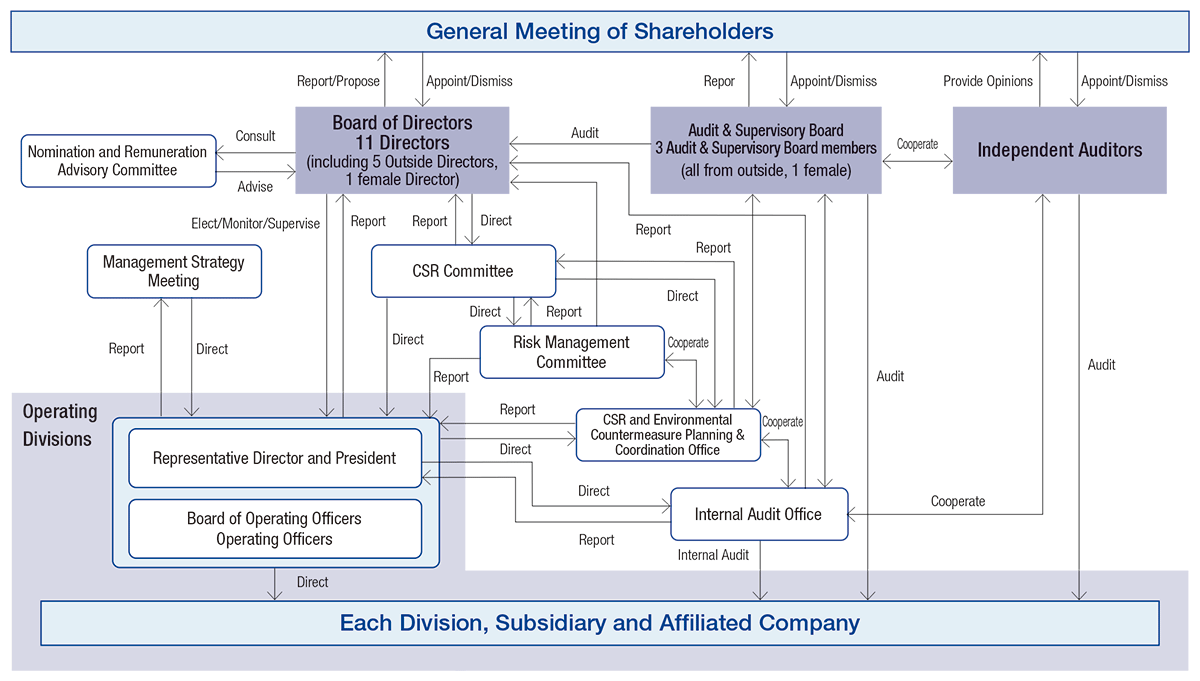
The above table can be viewed in its entirety by scrolling horizontally.
Compliance and Internal Control
Compliance
Policy for Promoting Compliance
The Komori Group ensures that all our officers and employees in Japan and overseas conduct their corporate activities in compliance with laws, regulations, social ethics, and respect for human rights based on the “Komori Group Code of Corporate Conduct” and the “Komori Group Employee Conduct Standards,” both formulated as basic guidelines for corporate activities. We position compliance as one of our key management priorities. Our CSR Committee formulates compliance policies, examines priority issues, responds to serious incidents, and considers measures to prevent recurrence, ensuring effectiveness under the supervision of management. Furthermore, we have established a compliance department and are working to promote and improve compliance awareness throughout the Komori Group, including through internal whistle-blowing hotlines that include those of our domestic group companies, and by conducting compliance training for all employees. Our goal is to continue to be a company that is trusted by our stakeholders.
Whistle-blowing System
The Komori Group has established an internal whistleblowing system with the aim of promptly detecting and correcting fraudulent activities and violations of laws and internal regulations, as well as fostering a sound corporate culture. In addition to an internal whistleblowing hotline, including those within our domestic group companies, we have established an external whistleblowing hotline run by third-party organizations, creating a system where executives and employees can consult and report issues with confidence. A report can be made anonymously, and we will thoroughly protect the confidentiality and privacy of the reporter, and we will prohibit any detrimental treatment as a result of making a report. We investigate and correct any reports we receive in cooperation with the relevant departments, implement measures to prevent recurrence as needed, and report important cases to management to facilitate organizational improvement.
Education and Training Activities
To ensure and improve compliance awareness, we continuously provide education and training tailored to different levels and roles within our organization. We deepen our management team's understanding of legal compliance and corporate ethics through training conducted by external experts. Furthermore, we conduct ongoing compliance training for all employees of our domestic group companies, aiming to foster an organizational culture where employees can think about and act on compliance in their daily work.
Internal control
| Internal control system | We have an internal control system in place, based on a basic policy for establishing it approved by the Board of Directors. We annually review and evaluate the operational status of the internal control system, reporting the results to the Board of Directors. |
|---|---|
| Internal audit | The Internal Audit Office, which directly reports to the President, conducts audits to ensure the proper and efficient execution of business operations throughout the entire Group. Audit results are reported to the President, Board of Directors, Audit and Supervisory Committee, and CSR Committee. |
| Cooperation with Audit and Supervisory Committee/ Independent Auditors |
We closely collaborate with the Audit and Supervisory Committee by regularly exchanging opinions, conducting joint audits, and sharing audit results, aiming to enhance the efficiency and quality of audits. We engage in discussions with our Independent Auditors through meetings on their semiannual review reports, interim/final audit result reports, and other occasions. |
Komori Group Basic Policy on Anti-bribery and Corruption
Enforced on December 26, 2017
Background
Laws and regulations controlling bribery and corruption have tightened on an international scale in recent years, with exposure of such activities becoming ever more severe. Although the Komori Group has always endeavored to prevent violations through our corporate behavior charter which includes the statement of "fair and transparent corporate activities in accordance with laws, regulations, and social ethics," and specifically defining employee standards of conduct as "prohibiting bribes to civil servants." In light of the global development of the Group's business, tightening laws and regulations, and more severe exposure of such activities, it is necessary for the Komori Group as a whole to further enhance measures against the risk of bribery.
Declaration
In 2011, the board of directors expressed their resolve to ensure that the Komori Group "takes a firm stance on preventing bribery." In view of increasing worldwide interest in preventing bribery such as the American Foreign Corrupt Practices Act, the British Bribery Act, the Chinese Commercial Bribery Regulations, and the Japanese Unfair Competition Law, we declare that the laws and regulations regarding anti-bribery measures that apply in the countries and regions where the Komori Group operates its businesses will be strictly adhered to, that reception of bribes is prohibited, and that accurate records of all Group transactions will be maintained. In addition to eliminating bribery from the businesses involved in the Group, we request that companies who conduct business on our behalf, whether fully or partially, and our partners in business dealings, be in compliance with anti-bribery laws and regulations in order to conduct our business with integrity.
Conditions
The Komori Group requests the following of all Group executives, employees, agents, and business partners.
1. Prohibition of bribes
Do not give, offer, promise, or accept bribes to or from any person, whether directly or indirectly.
2. Proper authorization procedures and follow-up confirmation procedures
Payments to public officials must conform to proper authorization procedures and proper follow-up confirmation (review procedures). The same also applies to payments to executives of private enterprises.
3. Understand and abide by Komori Group policy on bribery regulations
Undergo training to sufficiently understand and abide by laws and regulations on bribery and the Komori Group code of conduct.
4. Due diligence and introduction of anti-bribery clauses by agents and business partners
Business may only be conducted with legitimate and trustworthy agents and business partners, due diligence must be conducted before executing business with such persons, and the contract concluded with such parties must contain an anti-bribery clause.
5. Periodic risk evaluation
Bribery risk evaluation must be conducted periodically for all Komori Group companies.
6. Records maintenance
Records must be maintained in order to show compliance with bribery-related laws and regulations and the Komori Group code of conduct.
7. Periodic review and improvements
The code of conduct and controls for preventing bribery and corruption must be periodically reviewed and amended/improved as necessary.
8. Prompt reporting
If any Komori Group executive, employee, agent, or business partner is suspected of violating the anti-bribery laws and regulations or the terms of this policy, a report must be promptly filed with the immediate supervisor or supervisor of the department in charge in order to take timely and appropriate measures.
Definitions
- "Public officials" include all public officials, members of a political party, official candidates, and state-owned businesses and businesses under the control of the government (examples include employees and executives at a state-owned bank).
- "Agents" refer to persons who act as an intermediary in transactions or act on behalf of or as an intermediary for the Komori Group.
- "Business partners" refers to those with whom the Komori Group conducts business.
- "Bribes" denotes presenting something of value to a civil servant or other party with the goal of obtaining or maintaining business or obtaining unfair advantages, and a so-called facilitation payment (payment intended to facilitate government affairs) would constitute a bribe.
- The "code of conduct" is a set of rules and concepts that must be followed by all Komori Group executives and employees which covers the policy, regulations, standards, and guidelines on preventing bribery and includes the Komori Group Basic Policy on Anti-bribery and Corruption.
Risk Management
We have identified individual risks in the Komori Group and examined countermeasures for them at various meetings, and responded to issues in daily operations to a certain extent. However, as the environment surrounding us is changing, there are concerns that any lack in common understanding and partnership between departments regarding important risks could lead to a delay in taking countermeasures. Therefore, the CSR and Environmental Countermeasure Planning & Coordination Office is working together with each department to narrow down and manage 17 risk factors, in view of the severity of the risks we faced in the past and the priority of risks we are currently facing.
In our internal activities, the risk management organization headed by CEO was formed, taking responsibility for identifying and assessing risks from group-wide perspectives. In accordance with the Regulations for Risk Management and the Operational Guidelines for Risk Management established to this end, we set up the Risk Management Committee which is responsible for formulating the group-wide risk management policy, reviewing the risk management system, monitoring the status of measures taken for each individual risk, and implementing necessary follow-up action. The status of progress is reported to the CSR Committee quarterly and the Board of Directors as necessary. The emergency headquarters will be in charge for risks in emergencies.
| Risk type | Risk factor | Number of risk factors |
| 1.Management risk of overseas |
|
3 |
|---|---|---|
| 2.Hazard risk |
|
3 |
| 3.Market volatility risk (Market monitoring risk) |
|
2 |
| 4.New business management risk |
|
2 |
| 5.Supply chain risk (Parts supply risk) |
|
2 |
| 6.Risk related to environment/climate change |
|
2 |
| 7.Risk related to human resources |
|
2 |
| 8.Risk related to compliance |
|
1 |
The above table can be viewed in its entirety by scrolling horizontally.
Information Security
Risk related to information security breaches
If information security is breached, resulting in information leaks, destruction or falsification of data, or suspension of operations or services, it could not only affect our Group's business performance but also lead to a loss of trust in our group.
To this end, our Group has established policies for the promotion of information security in the form of Information Security Standards and specific guidelines for usage and operation rules, as well as an IT Security Committee as a promotion organization, which is responsible for building, maintaining, and improving security systems, including those of Japan and overseas Group companies. In addition, regular vulnerability and risk assessments are carried out to identify risks at an early stage and establish a system for taking countermeasures.
We will continue to monitor changes in threat trends and continue our cybersecurity initiatives.